Steel dimension mistakes and their hidden cost
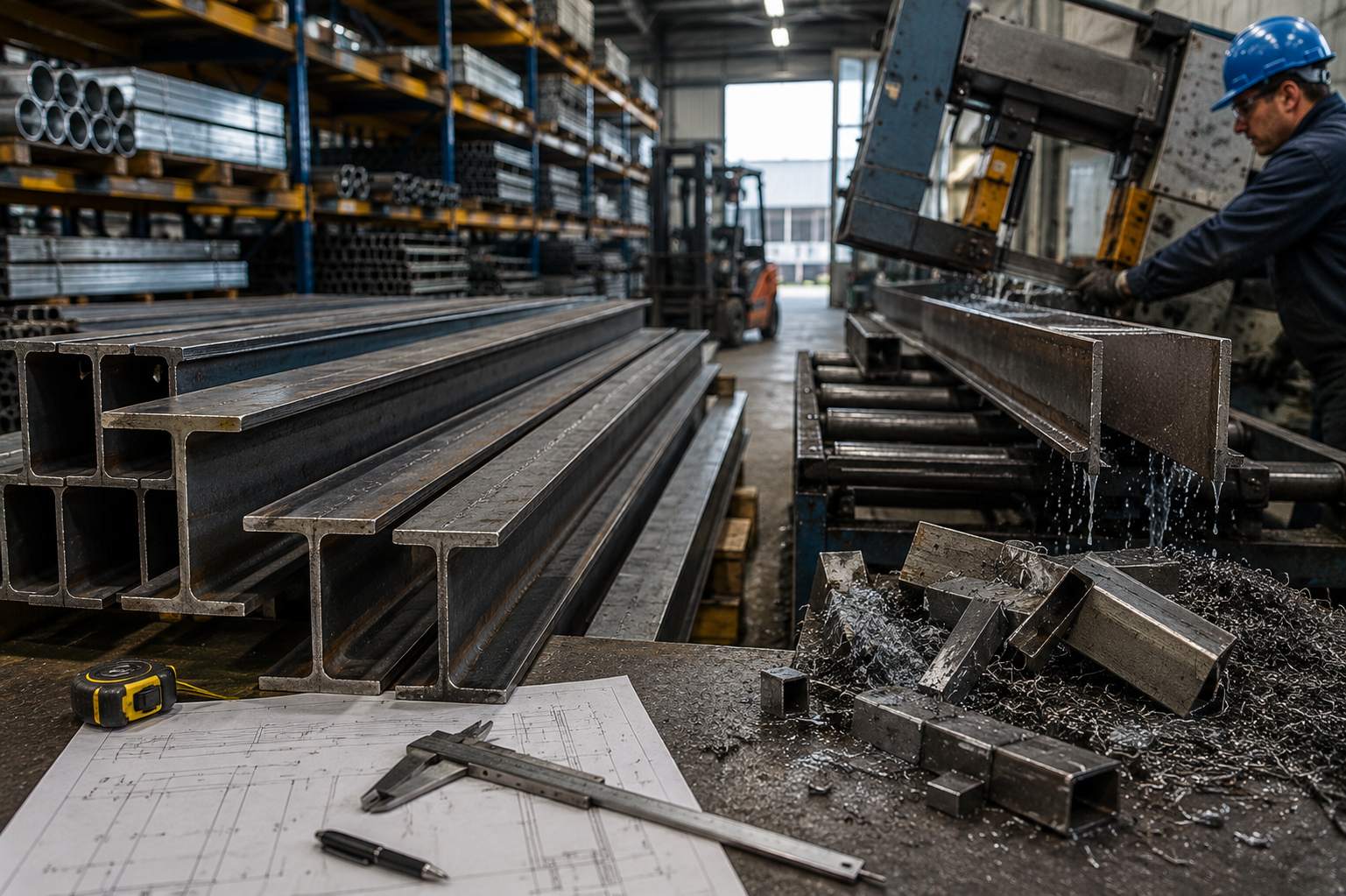
A beam cut one millimeter too wide does not only waste material. It burns machine time and pushes back delivery. Often it reshuffles the whole production schedule too. Most buyers assume the problem is a wrong order. The actual problem sits earlier: the order rarely starts from what is already sitting on a warehouse shelf.
Why the drawing is not the right starting point
Engineers and private builders typically design toward an ideal dimension pulled from a spec sheet, without first checking which profiles a distributor such as Tibnor Steel distributor already stocks. It feels precise. It is rarely practical.
The moment a drawing calls for 148 millimeters instead of a standard 150, the supplier must either trim stock down or place a special mill order. Turning the job away happens too, more often than buyers expect. Even a 2 mm gap forces extra processing that a standard steel section would skip entirely, because the saw needs a separate setup calibrated for one odd length.
The real price of a custom cut profile
Every nonstandard cut adds a second layer of cost on top of the raw material price. Sawing time and handling add to the bill, and the setup fee often outweighs the value of the metal actually removed. A workshop rarely itemizes this separately, so buyers see one invoice and assume that is simply the price of the material. The quieter loss sits in the kerf, the sliver the blade removes with every pass, and in the offcut left behind: a trimmed length of bar stock, whether steel or another metal, rarely matches typical resale dimensions, so it lands in a scrap bin instead of going back onto the shelf. Neither the buyer nor the distributor recovers that value efficiently. The material leaves the supply chain years before it should. Talk to a saw operator and the story is always the same: in practice, the setup is what drains the budget, not the cut itself. Changing the blade angle for one odd length takes longer than three standard cuts combined.
The lead time nobody budgets for
Mills batch-produce to standard runs, so a dimension outside that range usually has to be ordered specially from the mill itself, not pulled off a warehouse shelf. The order therefore turns a delivery measured in days into one measured in weeks.
Precision has an image problem here. An exact, nonstandard measurement reads as more professional, more considered, but it usually buys nothing beyond a longer schedule and a higher price. The tolerance behind it is rarely one the project actually needed.
Matching design to stock format from the start
Choosing a standardized dimension from an established distributor cuts scrap and processing time in one move. The wait disappears too, because the material already exists in the size the project needs. That single change removes three cost categories at once, rather than trimming each one separately later.
This is where stock breadth matters more than any spec sheet. A broad stock range across steel and other metals in common dimensions makes it possible to fit the design to an available format before the first cut, not after.
The hidden cost of choosing the wrong dimension rarely shows up at the point of ordering. It shows up later, when the drawing has dictated the measurement instead of the warehouse shelf. Reverse that order, and the scrap disappears. The machining delay goes with it.