Signs Your Commercial Truck Needs Immediate Repairs
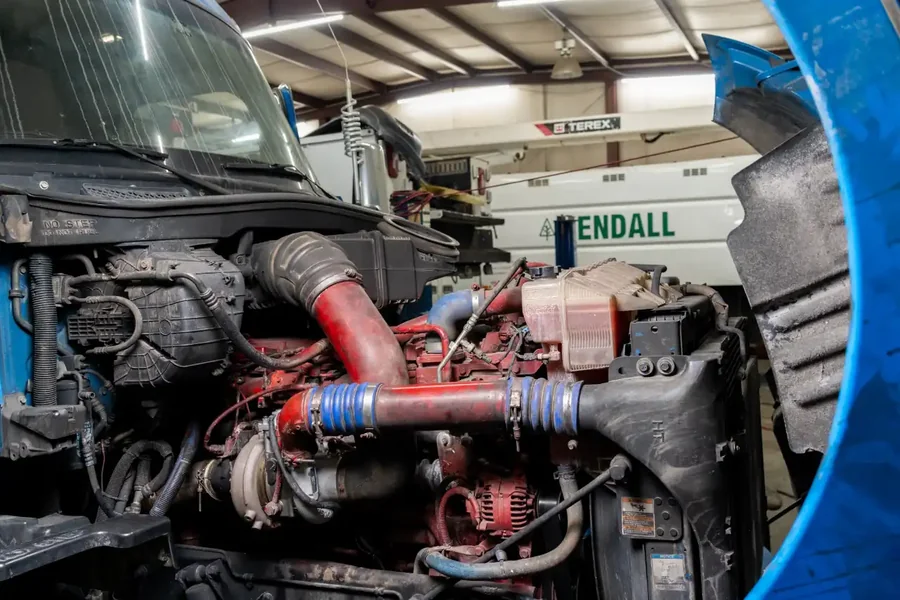
Commercial trucks don’t usually fail without warning. They telegraph the problem first — a noise that wasn’t there last week, a gauge reading that’s crept out of its normal range, a vibration that appears at a certain speed and disappears above it. The question is whether the person behind the wheel catches it early enough to act, or pushes through to the next stop because the schedule doesn’t have room for a delay.
That calculation tends to be expensive. A fault code ignored for two more days of running can turn a $400 sensor swap into a $4,000 aftertreatment replacement. A brake pull dismissed as road crown can mean failed linings and a rotor by the next DOT stop. This isn’t about scaremongering — it’s about reading the signals your truck is actually sending and knowing which ones require immediate action, not a “watch and wait” approach.
Warning Signs in the Engine and Cooling System
Temperature Gauge Moving Out of Normal Range
The coolant temperature gauge should sit in the middle of its operating range under normal load. If it climbs toward the high end — or spikes — that’s not a monitor-and-continue situation. Overheating events cause head gasket failure, liner protrusion in wet-sleeve block designs, and in serious cases, warped heads that require machine shop work before reassembly. Pull over, let the engine cool, find out why.
A gauge that runs consistently low is its own problem. A thermostat stuck open keeps coolant circulating before the engine reaches operating temperature, increasing fuel consumption, accelerating cylinder wear, and preventing the DPF from reaching passive regeneration temperatures.
Oil Pressure Warning or Abnormal Gauge Readings
An oil pressure warning on a heavy diesel is not a suggestion to find a shop when convenient. Low oil pressure means engine bearings are running without adequate film — metal-to-metal contact is occurring or imminent. Every mile with low oil pressure shortens remaining engine life or ends it. If the warning illuminates and stays on, pull off safely, shut down, and diagnose from a stopped position. Pressure that fluctuates at idle but recovers at speed points to oil pump wear, a clogged pickup tube, or bearing wear the pump can no longer compensate for at low RPM.
Excessive or Unusual Exhaust Smoke
Blue smoke means oil is burning in the combustion chamber — valve stem seals, piston rings, or turbocharger seal failure. Persistent white smoke after warmup indicates coolant entering the combustion space from a failed head gasket or cracked EGR cooler. Heavy, consistent black smoke points to a fueling or air supply problem: clogged air filter, failing injectors, or a turbocharger below rated boost. Any of these warrants attention before the next run.
Brake System Red Flags
Pull, Vibration, or Grabbing Under Braking
A truck that pulls to one side when braking has a brake system working unevenly — seized brake chamber, failed slack adjuster, uneven lining wear, or contaminated friction material. That’s a vehicle control problem, not just wear. Vibration through the pedal or steering wheel typically means rotor damage from worn linings or heat-warped rotors. Grabbing under light pedal application usually points to gear oil contamination of the lining surface from a leaking axle seal.
Low Air Pressure Build-Up or Constant Compressor Cycling
Federal Motor Carrier Safety Administration (FMCSA) regulations require air brake systems to build from 85 to 100 psi in under 45 seconds at governed RPM. A truck that takes significantly longer — or whose compressor cycles constantly to maintain pressure — has a leak somewhere: cracked air line fittings, a failing service valve, or a leaking drain valve. Driving with an air system that can’t hold pressure is an immediate out-of-service condition under Commercial Vehicle Safety Alliance (CVSA) standards. The truck shouldn’t leave the yard until the leak is found and fixed.
Electrical and Fault Code Signals
Modern commercial trucks generate fault codes continuously. Not every active code represents an immediate danger — some are informational, some represent intermittent sensor glitches. But a few fault code categories demand prompt action.
Active Derate Events
When a late-model diesel truck enters an active derate — also called “limp mode” — the engine control module has detected a fault serious enough to deliberately limit power output. Typical derate triggers include SCR system faults (NOx sensor failure, DEF quality issues, SCR catalyst efficiency below threshold), DPF over-pressure, or engine protection events from oil pressure or coolant temperature readings. A truck in active derate making 40% to 60% of rated power is a truck that needs diagnosis, not continued operation.
The specific fault codes active during a derate event tell a trained technician exactly where to start. Continuing to run a truck in derate without addressing the underlying fault often makes the problem more expensive to resolve — not less — because the root cause continues to develop while the control system compensates for it.
Persistent Check Engine or MIL Illumination
A malfunction indicator lamp (MIL) that illuminates and clears itself intermittently is worth monitoring. A MIL that stays on across multiple ignition cycles has set a stored fault code that needs retrieval with a diagnostic tool. The fault might be an emissions-related issue that will eventually produce a derate, or it might be a sensor that’s failed in a way that hasn’t yet triggered protective action from the ECM. Either way, the code exists for a reason, and leaving it unread means operating with less information than the truck is trying to give you.
Steering and Handling Changes
Increased Steering Effort or Wandering
Heavy steering that wasn’t there before points to power steering issues — low fluid, a failing pump, or a worn steering gear box. Left unaddressed, a failing system can fail completely at the worst possible moment: loading dock, on-ramp, highway merge. Wandering — constant minor corrections to hold a straight line — comes from worn kingpins, loose tie rod ends, or a gear box with excessive play. These are DOT-citable conditions and they accelerate steer tire wear, which compounds the cost of deferring the repair.
Vibration at Highway Speed
Speed-dependent vibration is almost always wheel balance or a driveline issue. Tire-related vibration peaks at a specific speed and smooths above it. Driveline vibration from a failing U-joint or damaged carrier bearing is more constant and felt through the seat as much as the wheel. Unaddressed driveline vibration destroys U-joints, damages the transmission tailshaft, and in serious cases causes a driveshaft failure at speed.
Fluid Leaks and What They Actually Mean
Fluid on the ground under a parked truck is a communication. The location, color, and consistency of the fluid narrows down the source quickly.
Green or orange coolant pooling under the front of the engine points to a hose, water pump, or radiator issue. Dark brown or black oil near the front crankshaft seal or oil pan gasket indicates an oil leak that will only worsen over time and distance. Reddish-brown gear oil under the axle housing suggests an axle seal failure — the same gear oil that can migrate onto brake linings and destroy them. Fuel on the ground is a fire hazard and an immediate out-of-service condition in most jurisdictions.
A small leak that’s been “stable” for weeks is only stable until it isn’t. Gaskets deteriorate. Seals shrink in cold weather. What was a weep becomes a drip becomes something that creates a DOT violation at the next inspection or a breakdown call at the worst possible time.
When the Truck Needs to Stop Running
Some warning signs fall into the “address soon” category. Others mean the truck shouldn’t move until it’s been looked at. Knowing the difference matters.
Stop the truck immediately for: oil pressure warning that stays on, coolant temperature in the red, smoke from the exhaust in white or blue, brake fade or loss of pedal, or any failure that changes steering response suddenly and significantly. These are conditions where continued operation risks catastrophic mechanical damage or a loss-of-control event.
Get the truck to a shop before the next run for: persistent active fault codes, air brake system slow to build pressure, fluid leaks that have gotten worse, vibration that has increased since the last trip, or any brake anomaly — pull, grab, or grinding noise — that appeared on the previous run.
For trucks that need immediate diagnosis or can’t make it to a fixed facility, operators throughout the Northeast running into situations requiring professional heavy duty truck repair need technicians who understand both the urgency of commercial schedules and the technical complexity of modern diesel systems — not a shop that treats a Class 8 like a scaled-up pickup.
Signs Your Commercial Truck Needs Immediate Repairs: Acting on What You Know
The pattern that runs through every category above is the same: the truck communicates, the operator interprets, and the action taken determines what the final cost ends up being. Signs your commercial truck needs immediate repairs are rarely subtle — they show up on gauges, in smoke, through the steering wheel, under the chassis. The signals exist. The question is whether they get acted on in time.
Drivers and fleet managers who treat these signals as actionable information — rather than inconveniences to be managed around — spend less on repairs over the life of a vehicle and deal with fewer roadside situations. When a roadside situation happens anyway, having professional semi truck towing and repair response available significantly limits the damage that a breakdown causes to schedules, cargo, and operating costs. The truck will tell you what it needs. The job is to listen before it gets loud.