10GBASE-T SFP+ vs 10G SFP+ Optical Modules: Which One Is More Suitable?
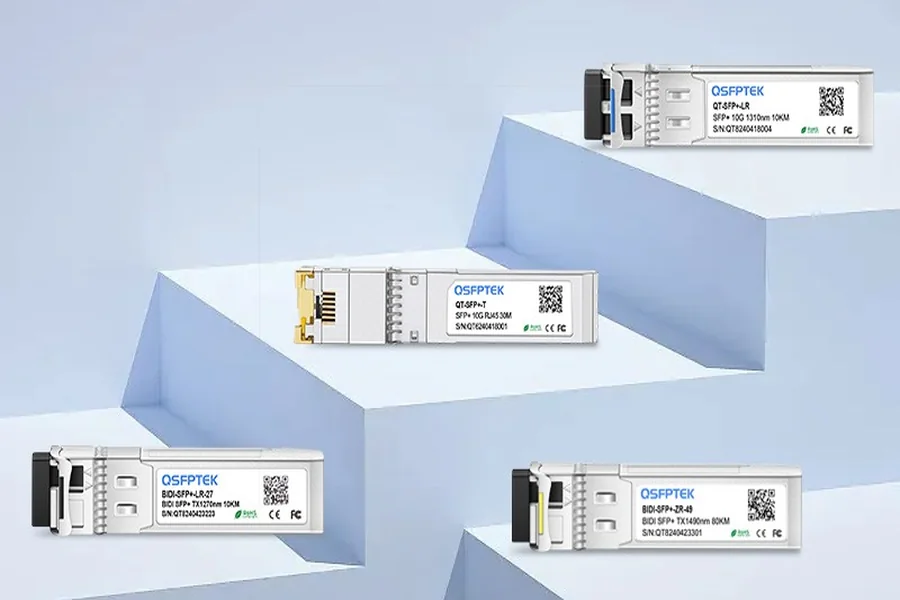
As modern networks continue to evolve, the demand for higher-speed connectivity has become critical for both data centers and enterprise environments. With the rise of 10 Gigabit Ethernet, network designers are often faced with the decision of whether to deploy 10G SFP+ modules in copper or optical form. While both solutions are capable of delivering 10Gbps bandwidth, they differ significantly in terms of cabling requirements, deployment flexibility, cost, and performance characteristics. Understanding these differences is essential for selecting the most appropriate solution for a given network scenario.
The term 10GBASE-T SFP+ refers to copper-based transceivers that allow standard RJ-45 connections over Cat6a or Cat7 cabling for distances up to 30 meters. On the other hand, optical 10G SFP+ modules, such as 10GBASE-SR or 10GBASE-LR, rely on fiber optic transmission to achieve longer distances, sometimes reaching several kilometers. Both options have their unique advantages, but their suitability depends heavily on the specific network topology and operational requirements. By examining the differences in cost, installation, performance, and scalability, network planners can make informed decisions about which module type is best suited for their environment.
As enterprises upgrade their network infrastructure, many IT teams consider how to integrate high-speed links with existing equipment. One of the major benefits of 10G SFP+ modules is their modularity. Switches with SFP+ ports can accept either copper or optical modules, providing flexibility to match current cabling while retaining the ability to upgrade later. This versatility allows organizations to plan for future growth without committing to a single technology from the outset.
Performance and Distance Considerations
Transmission Distance and Signal Integrity
One of the most obvious differences between 10GBASE-T SFP+ and optical 10G SFP+ modules lies in the transmission distance they can support. Copper-based 10GBASE-T modules are designed for short-distance connections, typically up to 30 meters over Cat6a cables and up to 100 meters over Cat7 in ideal conditions. This limitation makes them ideal for connecting servers to top-of-rack switches within a single rack or adjacent racks in a data center. Beyond these distances, signal attenuation and crosstalk become significant concerns, which may require additional repeaters or alternative cabling solutions.
In contrast, optical 10G SFP+ modules can transmit data over much longer distances. Multi-mode fiber (10GBASE-SR) supports up to 300 meters using OM3 fiber and up to 400 meters with OM4 fiber, while single-mode fiber (10GBASE-LR) can extend links up to 10 kilometers. This makes optical modules highly suitable for connecting different rooms, floors, or even buildings. When distance is a critical factor, optical 10G SFP+ modules clearly outperform copper alternatives in both reliability and signal integrity.
Bandwidth and Latency
Both copper and optical 10G SFP+ modules provide the same nominal bandwidth of 10Gbps, but there are differences in latency and power consumption. Copper 10GBASE-T modules generally introduce higher latency, ranging from 2 to 4 microseconds per link, due to the signal processing required for twisted-pair transmission. Optical modules, on the other hand, offer lower latency because light travels faster through fiber and less signal processing is required. For latency-sensitive applications, such as high-frequency trading or real-time analytics, optical 10G SFP+ modules may be preferable.
Cost and Deployment Factors
Initial Investment and Cabling Requirements
Cost is a major factor in deciding between copper and optical 10G SFP+ modules. Copper modules are typically less expensive than optical ones, and they leverage existing Cat6a or Cat7 cabling infrastructure, reducing the need for additional investment. This makes them particularly appealing for upgrading access layer connections in enterprise networks or for short-distance server-to-switch links in data centers. Installation is also simpler, as RJ-45 connectors are widely understood and easier to terminate compared to fiber connectors.
Optical 10G SFP+ modules require fiber patch cords, transceivers, and often new cabling pathways if fiber infrastructure is not already in place. This increases the initial deployment cost. However, optical cabling offers better long-term flexibility and future-proofing, allowing networks to scale to 25G, 40G, or even 100G speeds by upgrading the transceivers without replacing the fiber infrastructure.
Ease of Installation and Maintenance
Copper 10GBASE-T modules provide a plug-and-play solution that IT staff are generally familiar with. Troubleshooting and maintenance are straightforward with standard Ethernet testing tools. Optical 10G SFP+ modules require careful handling of fiber connectors to avoid contamination or signal loss, as well as specialized tools for testing and certifying fiber links. While the learning curve is slightly steeper, the reliability and performance benefits often outweigh the added complexity in medium- to long-distance deployments.
Flexibility and Future-Proofing
Scalability of Network Design
The modular nature of SFP+ ports allows network switches to accommodate a mix of copper and optical modules. In practice, this flexibility means that IT teams can deploy 10GBASE-T SFP+ for short-distance links while using optical 10G SFP+ modules for longer runs. As network demands grow, switches with modular SFP+ slots can be upgraded without replacing the chassis, reducing long-term capital expenditure.
Optical 10G SFP+ modules are particularly advantageous for future-proofing the network. While 10GBASE-T may remain sufficient for access-layer connections in many environments, core and aggregation layers increasingly benefit from fiber optics to support higher bandwidth and longer distances. By designing a hybrid network that combines copper and optical SFP+ modules, organizations can optimize both cost and performance while preparing for future upgrades.
Conclusion
Choosing between 10GBASE-T SFP+ and optical 10G SFP+ modules ultimately depends on the specific requirements of the network deployment. Copper 10GBASE-T modules are ideal for short-distance links where existing cabling infrastructure can be leveraged, offering simplicity, cost savings, and ease of installation. Optical 10G SFP+ modules, while more expensive, provide longer reach, lower latency, and future scalability that make them well suited for connecting different floors, buildings, or data centers.
For IT professionals planning 10G networks, understanding the trade-offs between copper and optical SFP+ modules is essential. By carefully evaluating factors such as distance, latency, cost, and deployment complexity, network designers can select the most suitable solution for each segment of the network. Ultimately, combining both types of modules in a modular SFP+ architecture provides the flexibility and performance necessary to meet today’s demands and future-proof tomorrow’s high-speed infrastructure.